

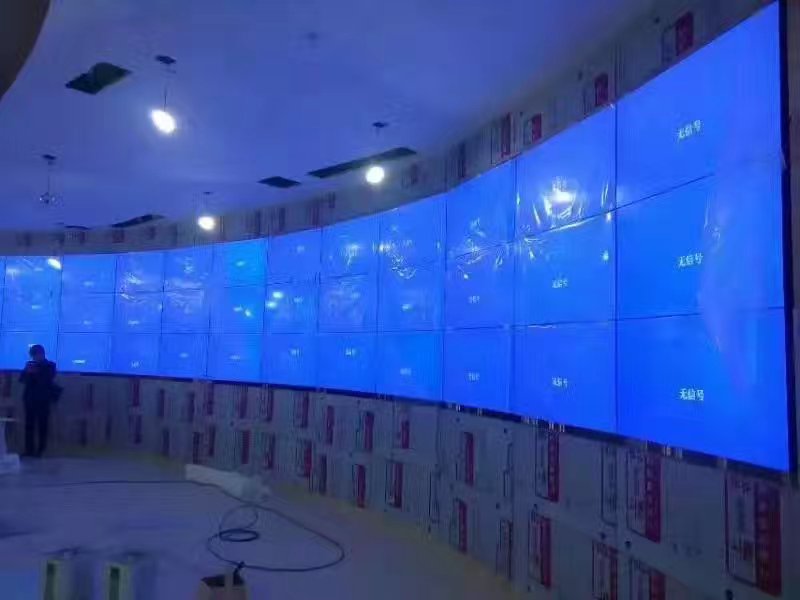
3×12 Curved LCD Video Wall for Large Command Centers
Description
A Thirty-Six-Panel Curved Information Surface
A 3×12 curved LCD video wall for command centers contains thirty-six panels arranged in three rows and twelve columns. The front-end product image clearly shows a curved installation, making this configuration suitable for large command, smart-city, energy, and integrated operations environments.
Three rows provide height for maps, video, data, and status bars, while twelve columns allow regional or departmental information to extend across the room. Curving the wall directs the far ends toward the central observation area.
Define Curvature from Real Viewing Positions
A stronger curve is not automatically better. Room width, the main observation point, first and rear row distances, and the far-left and far-right seats determine the appropriate geometry. Excessive curvature consumes space and complicates mapping and service access.
Plan the 3×12 curved LCD video wall for command centers on a floor drawing that shows every panel angle, console position, rack, and maintenance route. Important information should remain readable from the seats that use it.
Install and Align the Structure in Controlled Stages
Thirty-six panels should not be assembled by improvising with unrelated flat brackets. The load-bearing structure, curve reference, cable path, and panel sequence must be designed together. Complete the structural base first, then install and align by zone before whole-wall calibration.
Small errors multiply across twelve columns. The center and both ends need reliable references for level, vertical alignment, angle, and bezel spacing. Structural acceptance must also cover floor or wall load and service clearance.
Build Control Around Business Zones
A 3×12 curved LCD video wall for command centers may receive surveillance platforms, maps, conferencing, operational workstations, and visualization servers. Thirty-six display outputs are required, but the input and window design must follow the business systems rather than panel count alone.
Define permanent operating zones, the shared main image, temporary incident windows, reporting modes, and user permissions before selecting the controller. Separate departments should not be able to disrupt the complete wall unintentionally.
Treat Power, Cooling, and Labels as One System
Thirty-six panels create many signal and power connections. Distribute power, rack space, and ventilation so that one inaccessible point does not contain every dependency. Each screen, output, input, and physical position should use the same numbering plan.
Accurate diagrams allow a technician to isolate a local black screen without dismantling unrelated sections. A maintainable 3×12 curved LCD video wall for command centers needs documentation as much as hardware.
Accept Local Zones and the Complete Curve
Use grids, straight lines, text, and moving images to inspect curvature, output mapping, bezel continuity, and synchronization. Then test each operating zone, cross-zone windows, preset changes, power recovery, and sustained operation.
Observers should inspect the 3×12 curved LCD video wall for command centers from several console and meeting positions. Handover is complete only when the end panels remain readable and technicians can safely reach panels, cables, and processing equipment.
Frequently Asked Questions
How many panels are used in a 3×12 LCD video wall?
Three rows by twelve columns require thirty-six panels. The controller must provide the corresponding display outputs.
Why use a curved structure for a large command wall?
A site-designed curve can turn the end panels toward the central observation area and improve edge viewing in a wide room.
Can standard flat brackets be combined into the curve?
A thirty-six-panel project should use a coordinated structure with defined angles, load capacity, alignment references, and service access.
Does one panel fault require the whole wall to stop?
That depends on the power, signal, and maintenance design. Segmented planning and clear labels can reduce the effect of a local fault.
What must be checked during curved-wall acceptance?
Check structural continuity, panel angles, mapping, alignment, multiple viewing positions, local zones, full-wall content, recovery, and sustained operation.
Inquiry
You must be logged in to post a review.
Related products
-
3×6 LCD Video Wall for Corporate Experience Centers
Make the Display Part of…
-

3×3 LCD Video Wall for Industrial Process Monitoring
Build the Wall Around the…
-
5×6 LCD Video Wall for Enterprise Operation Centers
Make Thirty Panels Serve Business…
-
2×1 Vertical LCD Video Wall for Retail Stores
Use Vertical Space for a…
Reviews
There are no reviews yet.